For UK SMEs that want to accelerate AI use
Get AI under control. Then make it pay.
If you don’t know where your org uses AI, and your people don’t know its limitations you can’t harness AI for real gains.
We discover where it’s actually used, train your people then build the workflows to boost your capacity without extra headcount.
“We get your AI use under control, train your people, then build the systems that make it pay. Run by a team that ships AI products, not just talks about them”
– Alan Bates, Founder, 10 Kinds & Bazam.ai
![map[class:max-w-full mt-8 object-cover object-center rounded-4xl src:images/hero.jpg]](https://www.10kinds.co.uk/images/hero.jpg)
A UK AI consultancy working with SMEs on AI governance, training and custom build to drive lasting value.
A UK AI consultancy working with SMEs on AI governance, training and custom build to drive lasting value.
10 Kinds is a UK AI consultancy for SMEs. We get the AI already running in your business under control, teach your people to use it well, and build the systems that automate slow work. Gains typically show in 6 to 12 months, without adding headcount.
Discover One accurate list of every AI tool in use, including the ones nobody approved, plus a ranked shortlist of the manual work worth automating.
Foundations A signed policy, your people trained desk to board, and ISO/IEC 42001 evidence. The cultural change is what unlocks the value; the paperwork falls out of it.
Takeoff Working systems doing the slow work, the before and after measured, and a retainer keeping them alive so the gains hold.
What changes
Two things. You can prove AI is controlled, and the slow work stops being done by hand.
Typical improvements
40%
less time on professional writing tasks, with quality rated 18% higher
15%
more work completed per hour, measured across 5,172 support staff
The largest gains go to less experienced staff and capability is what turns a tool into real savings. That’s why training matters more than tools.
Sources: Noy & Zhang, Science, 2023 and Brynjolfsson, Li & Raymond, Quarterly Journal of Economics, 2025.
A questionnaire arrives. Sales goes quiet for three weeks.
You answer it that week, from documents you already have.
Nobody can say how many AI tools are in use.
There's a list. It has an owner. It's current.
A few enthusiasts use AI. Everyone else works around it.
Using it well is how the job gets done here.
The slow document work gets absorbed as normal.
It runs on a schedule, not on someone remembering.
Discover, Foundations, Takeoff
In that order, because each phase is what makes the next safe to do fast. Start where you are and stop whenever you want. Most organisations run the arc over 6 to 12 months.
Discover
You cannot govern or automate what you cannot see.
We find every AI tool in use, including the ones nobody approved. We find the manual work costing you most. And we find out how your people already work, because that decides what sticks later.
You get
- A map of every AI tool running in your business
- A ranked shortlist of where AI would pay
- A risk register covering data, suppliers and regulation
Foundations
Without cultural change, policies are just documents.
This phase supports change in how people work, and it's the one most consultancies skip. Rules get agreed by the people who have to enforce them. Then everyone gets taught so using AI well is normal.
You get
- An acceptable use policy your leadership has signed
- Staff and board trained on what’s allowed and how to use these tools well
- Controls and evidence mapped to ISO/IEC 42001
- Support through adoption, rather than a handover at the door
Takeoff
The people advising you build this for a living.
Now we build. We prototype the process most worth fixing, ship what proves out, and measure the before and after. Live AI systems and management systems both rot without upkeep, so we stay on.
You get
- Working systems in real use, not a prototype in a drawer
- The before and after measured, so you can see what changed
- A standing monthly line to the people who built them
Every stage is a fixed price against a written scope and we provide on-going support. See the six stages in full.
Three ways in
Pick whichever matches what’s in front of you.
Get in control
AI governance
Find every AI tool in use. Agree the rules. Get to where you can answer a customer's questionnaire the week it arrives.
- An AI inventory, including the tools nobody approved
- An acceptable use policy your leadership has signed
- Controls and evidence mapped to ISO/IEC 42001
- A plain read on what the EU AI Act asks of you
Get your people using it
AI training
Most people were handed a licence and left to work it out. Days pitched at the level of the room: what these tools do well, where they break, how to tell.
- How to tell a good answer from a confident wrong one
- Checking habits built to outlast the current tools
- Team, whole-organisation and board days
- The competence ISO/IEC 42001 expects you to be able to show
Get building
AI that pays for itself
Your team absorbs slow, manual, document-shaped work as normal. We find the parts worth automating, then build and ship them.
- A working prototype before you commit to a build
- Custom builds embedded in how your teams already work
- Workflows that run on a schedule, not on someone remembering
- Built by people who ship AI products for a living
Every engagement is a fixed price against a written scope. See what everything costs.
Free download
Start by finding out where you are today
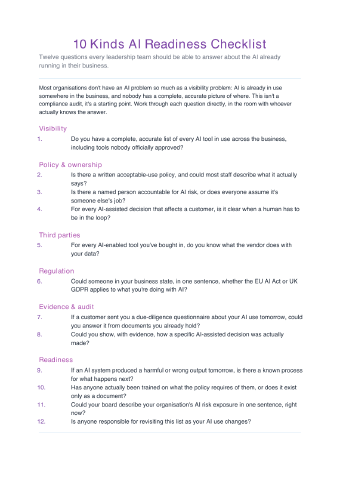
Twelve questions every leadership team should be able to answer about the AI already running in their business. It covers similar ground to a paid discovery engagement, condensed into something you can work through yourself in about ten minutes.
- Twelve questions across visibility, policy, suppliers, regulation and evidence
- Plain English, written for a leadership team rather than a compliance department
- A scoring note telling you what your answers mean
Battle-tested advice
We build this, not just advise on it
10 Kinds is run by the founder of Bazam.ai, an AI content marketing platform we designed, built and run in production. Everything we recommend to you, we have had to make work ourselves, with real data and real consequences when it goes wrong.
Multi-agent systems, in production
Agents that plan, draft and revise a piece of work between them, with a human approval step before anything goes out. We know when that architecture is worth its cost and when a single well-aimed prompt does the same job.
Retrieval over a customer's own material
A knowledge layer so output comes from the customer’s facts rather than the model’s guesses. This is the control most organisations need, and the one most vendors gloss over.
Workflows that run unattended
Approved, scheduled jobs publishing into multiple third-party platforms without anyone remembering to press anything, with a record of what ran and what it skipped.
Tenant separation that has to hold
One customer’s brand material must never surface in another’s output. Getting that right in a live system is a different discipline from writing a policy saying it must be.
That’s where the advice comes from. Which problems are worth pointing a model at, which are cheaper to solve with ordinary software, and which impressive demos fall apart the moment they meet real data. You get that read before the money goes anywhere.
![map[class:w-full rounded-3xl object-cover object-center src:images/headshot.jpg]](https://www.10kinds.co.uk/images/headshot.jpg)
- Founder, Bazam.ai
- AWS Certified Generative AI Developer, Professional, AWS’s top certification tier
- Postgraduate Diploma in Business Administration
- Based in the UK, working globally
Alan Bates
Founder, 10 Kinds
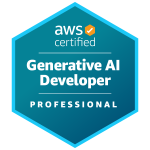
AWS's top certification tier
AWS Certified Generative AI Developer, Professional
AWS’s Professional tier, the top of its certification ladder. It’s the level AWS reserves for people already designing and running generative AI systems in production, not for anyone learning the basics.
Alan Bates is the founder of 10 Kinds, an AI consultancy that helps organisations get control of the AI they already use, then build valuable tools & workflows. He’s spent over 20 years working hands-on in technology, including multiple years at household names in media, telecoms and finance.
Alan is also the founder of Bazam.ai, an automated content marketing platform sold B2B. He also holds a Postgraduate Diploma in Business Administration, giving him formal grounding on the commercial side as well as the technical.
Building and shipping AI products himself is what shapes the judgement behind 10 Kinds’ advice: the controls an engineering team will follow, rather than the ones that read well in a policy document. The team works with leadership and engineering groups to find where AI risk sits, gets organisations ready for the moment someone asks them to prove it, and builds the systems that change how the business runs.
"Governance advice from someone who builds AI products, not someone who's only ever advised on them. I can talk risk and controls, and translate between compliance-speak, tech-speak and actual English"
Questions
What does 10 Kinds do? +
Three phases. Discover: we find where AI is already being used, including the tools nobody approved, and the manual work costing you most.
Foundations: the rules get agreed and everyone gets trained, desk to board. This is the phase that changes how people work, and it’s where most of the value is unlocked. The ISO/IEC 42001 evidence comes out of it.
Takeoff: we design, build and ship the systems that automate the slow work, then keep them running.
Most organisations arrive with the governance question because that’s what’s in front of them. You can start at any phase and stop after any of them.
We were sent a customer due-diligence questionnaire about our AI. Can you help? +
That’s the most common way people find us. Book a free call and bring it with you: we can discuss it, and what it would take to close the gaps.
Can you build things, or is it just advice? +
Both, and the building is the point. We design, build and ship AI systems ourselves rather than handing you a specification and wishing you luck. Governance is usually how organisations find us. Training is what changes how people work. Building is what changes what the business can do.
How do we get started? +
Book a free 30-minute call. If a questionnaire’s what brought you here, bring it along and we can discuss it. We’ll give you a straight read on where you stand and what the right next step looks like.
Start with a conversation
Half an hour on where you stand: what AI is running, how well your people use it, and what would be worth automating. Bring a customer questionnaire if that’s what brought you here.
You'll leave with a clear position on where you stand and what to fix first, whether or not you hire us.